
Many Forex traders spend countless hours watching charts, reacting to every price movement, and searching for the perfect entry. Yet some of the most successful traders take the opposite approach. Instead of focusing on short-term fluctuations, they follow the dominant market trend on the daily timeframe.
A trend following strategy on the daily chart is designed to capture larger market moves while filtering out much of the noise that exists on lower timeframes. Rather than predicting reversals or chasing every opportunity, traders aim to identify established trends and stay with them for as long as possible.

Why the Daily Timeframe Appeals to Trend Traders
The daily timeframe provides a broader view of market behavior. Each candle represents an entire trading day, making price movements more meaningful than those seen on intraday charts. This often results in cleaner trends, stronger support and resistance levels, and fewer false signals.
Another advantage is the reduced emotional pressure. Traders do not need to monitor charts constantly or make rapid decisions. Instead, they can analyze the market once a day and manage positions with a more structured approach.
Because daily charts contain less market noise, trend direction is often easier to identify. This can help traders avoid many of the whipsaws that frequently occur on lower timeframes.
Identifying the Trend
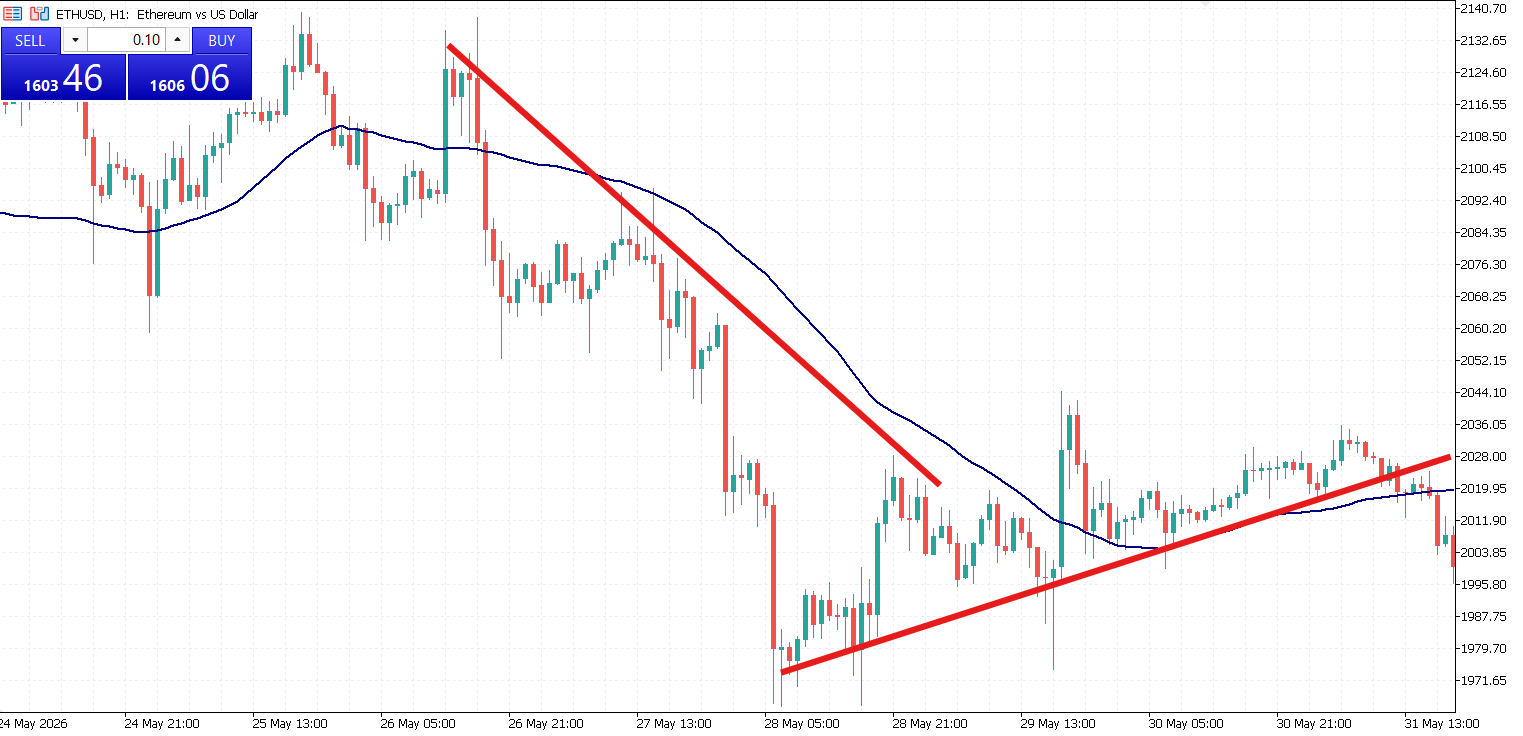
The foundation of any trend following strategy is determining whether the market is trending higher, trending lower, or moving sideways.
An uptrend is typically characterized by a series of higher highs and higher lows. Buyers remain in control, and pullbacks are usually followed by new advances. A downtrend shows the opposite behavior, with lower highs and lower lows indicating persistent selling pressure.
Many traders also use moving averages to help define trend direction. When price remains above a long-term moving average, the market may be considered bullish. When price trades below it, the market may be considered bearish.
The goal is not to catch the exact beginning of a trend. Instead, trend followers seek confirmation that a trend already exists before entering a position.
A Simple Daily Trend Following Process
A straightforward daily timeframe strategy often follows these steps:
- Identify the overall trend on the daily chart.
- Wait for a pullback within that trend.
- Look for a bullish or bearish price action signal near a key level.
- Enter in the direction of the prevailing trend.
- Place a stop-loss beyond a recent swing point.
- Allow the trade room to develop instead of taking profits too early.
This approach emphasizes patience. Many traders lose money because they feel compelled to trade constantly. Trend followers understand that quality setups may only appear a few times each month.

The Importance of Risk Management
Even the strongest trends eventually end. For this reason, risk management remains a critical part of any trading strategy.
Professional traders typically risk only a small percentage of their account on a single trade. This allows them to withstand periods of losses while remaining positioned to benefit when major trends emerge.
Stop-loss orders help limit downside risk and prevent a single trade from causing significant damage to trading capital. At the same time, profitable trades are often allowed to run longer than losing trades, creating a favorable risk-to-reward profile.
Trend following strategies often experience relatively low win rates compared to some short-term systems. However, the winning trades can be significantly larger than the losses, which is what ultimately drives profitability.

Common Mistakes When Trading Daily Trends
One of the biggest mistakes traders make is exiting profitable trades too early. Markets rarely move in a straight line, and temporary pullbacks are a natural part of any trend. Closing positions at the first sign of retracement can prevent traders from capturing the larger moves they are seeking.
Another common error is attempting to trade against the dominant trend. Countertrend trades may occasionally work, but they generally involve lower probabilities and greater uncertainty.
Impatience can also become a problem. Some traders force trades when no clear trend exists. Trend following works best when the market is showing strong directional movement, not when prices are trapped in a range.
A daily timeframe trend following strategy offers a simple and disciplined way to participate in the Forex market. By focusing on established trends, ignoring short-term noise, and applying sound risk management principles, traders can create a framework that is both practical and sustainable.
While no strategy guarantees success, trading in the direction of the prevailing trend has remained one of the most enduring concepts in financial markets. For traders who prefer a calmer and more methodical approach, the daily timeframe may provide the ideal balance between opportunity and simplicity.