
Trend following is a trading approach that aims to capture sustained price movements in one direction, either upward (bullish trend) or downward (bearish trend). Instead of predicting tops or bottoms, traders focus on identifying an existing trend early and staying with it as long as it remains intact.
In Forex, this typically involves using technical tools such as moving averages, price structure (higher highs and higher lows or lower highs and lower lows), and momentum indicators to confirm the direction of the market.
By reading this article, you will learn what trend following means in trading, why Forex markets are particularly suitable for trend-based strategies, and why the daily timeframe is so important for swing and position trading.
How Trend Following Works
Trend following works by identifying an existing market direction and aligning trades with that movement. Instead of trying to predict turning points, traders focus on confirming that a trend is already in place and then participating in it until it shows signs of weakening.
Core Principle of Trend Identification
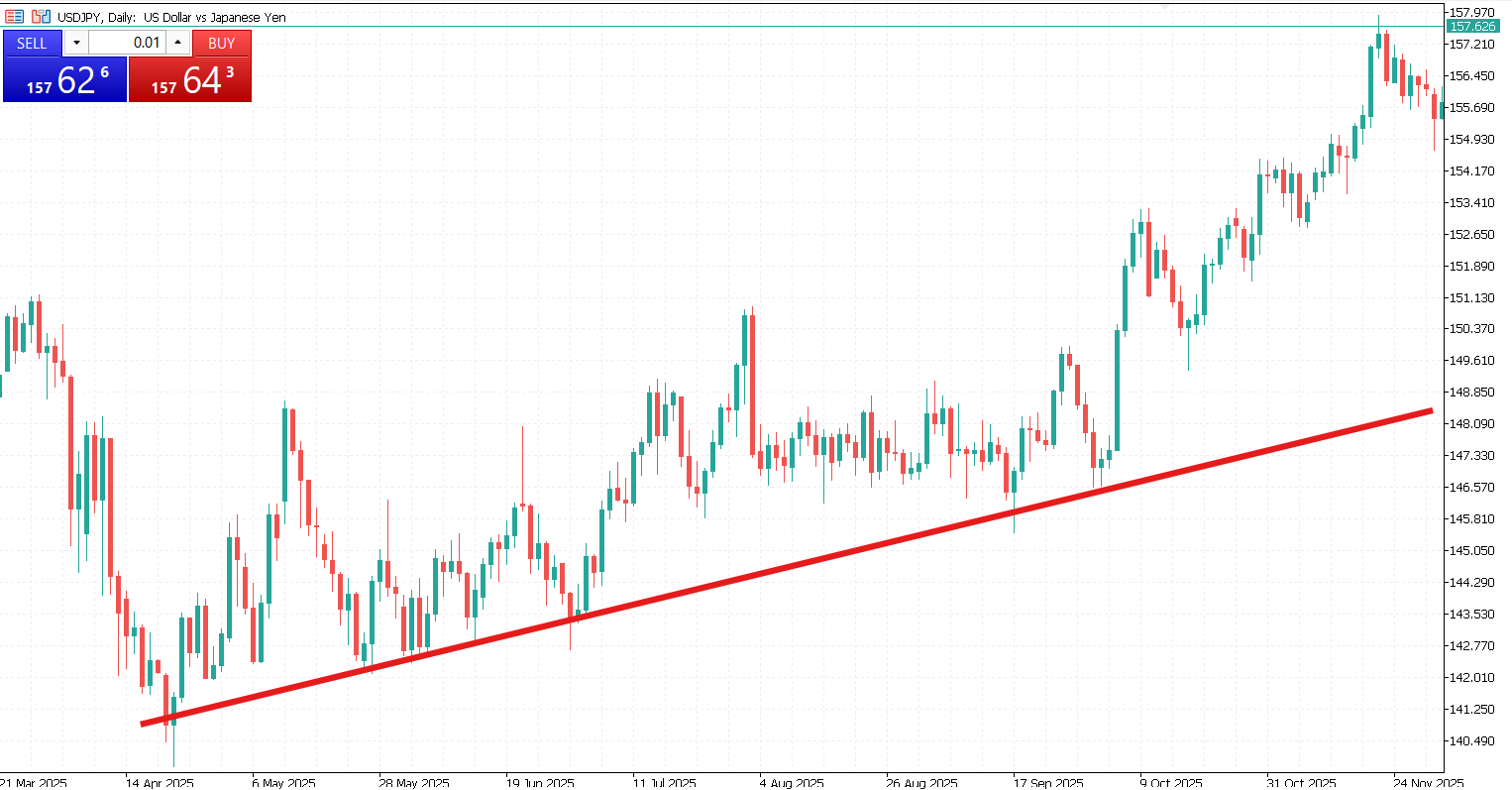
A trend is the general direction in which price moves over time. In an uptrend, the market forms a series of higher highs and higher lows, which indicates sustained buying pressure. In a downtrend, price creates lower highs and lower lows, showing sustained selling pressure. When the market is moving sideways, it trades within a horizontal range without a clear direction.
Trend followers also use price momentum and market structure to confirm whether a trend is strong or weak. Momentum reflects the strength behind price movement, while market structure helps traders determine whether buyers or sellers currently have control.
Entry and Exit Logic
Trend following does not try to predict reversals. Instead, it reacts to confirmed price behavior and enters trades only when the market shows a clear direction.
- Entry logic is based on trading in the direction of the existing trend. Traders typically use breakouts, when price moves beyond key support or resistance levels, or pullbacks, which are temporary retracements within an ongoing trend, as entry opportunities.
- Exit strategies focus on recognizing when a trend is weakening. Positions are closed when there are signs of trend exhaustion, such as declining momentum, structural breaks, or reversal patterns. Some traders also use trailing stops to protect profits while still allowing the trade to benefit if the trend continues.

Key Tools for Daily Timeframe Trend Following
Successful trend following on the daily timeframe relies on a combination of technical tools that help traders identify direction, confirm momentum, and manage risk.
Moving Averages
Moving averages are one of the most widely used tools in trend following because they smooth out price data and help identify the overall direction of the market.
- Simple Moving Average (SMA). Calculates the average price over a specific period and reacts more slowly to price changes
- Exponential Moving Average (EMA). Gives more weight to recent price action, making it more responsive to current market conditions
Traders often use moving average crossovers to confirm trends. For example, when a shorter-term EMA crosses above a longer-term EMA, it may signal the beginning of an uptrend, and vice versa for a downtrend.

Price Action Analysis
Price action is the foundation of trend identification and focuses on the raw movement of price without relying heavily on indicators.
Key concepts include price structure and market levels that help traders understand trend direction and strength. Higher highs and higher lows indicate a sustained uptrend, while lower highs and lower lows indicate a sustained downtrend. When price moves sideways, it often forms a range where support and resistance zones become important reference points.
Support and resistance levels are areas where price tends to react, pause, or reverse. By studying these structural elements, traders can better judge whether a trend is continuing with strength or starting to lose momentum.

Indicators Used in Trend Following
While price action is central, indicators can provide additional confirmation and improve decision-making.
- ATR (Average True Range). Measures market volatility, helping traders set stop-loss levels and understand how much price typically moves.
- RSI (Relative Strength Index). Helps confirm momentum by showing whether a market is overbought or oversold.
- ADX (Average Directional Index). Measures the strength of a trend, regardless of direction, helping traders avoid weak or sideways markets.
Building a Trend Following Forex Strategy
A successful trend following strategy is built on clear rules that define when to enter, manage, and exit trades. On the daily timeframe, the focus is on capturing larger market moves while avoiding short-term noise. The process is systematic and relies on consistency rather than prediction.
Step-by-Step Strategy Framework
A structured approach helps traders stay disciplined and avoid emotional decisions. Each step builds on the previous one to ensure trades are only taken when conditions are favorable.
- Identify the trend on the daily chart using price structure and moving averages.
- Wait for confirmation signals such as breakouts or pullbacks in the direction of the trend.
- Define entry rules based on specific conditions (e.g., candle close above resistance or MA support)
- Set stop-loss and take-profit levels before entering the trade, based on structure or volatility

Trend following remains one of the most widely used approaches in forex trading because it focuses on capturing sustained market moves rather than predicting short-term reversals. When applied correctly, it allows traders to align with the dominant direction of the market and benefit from extended price movements.
The daily timeframe plays a key role in this approach, as it filters out short-term noise while still offering enough trading opportunities. This balance helps traders focus on higher-quality setups driven by meaningful market structure rather than random fluctuations.
Ultimately, successful trend following requires patience and consistency. A long-term mindset is essential, as profitability comes from disciplined execution over many trades rather than individual outcomes.